Blog / Verdicts
Which Alpine ski resorts can you actually reach by train in 2026/27?
Station by station across France, Switzerland, Austria and Slovenia: where the train reaches the door, where a bus finishes it, and where neither does.
published 17 Sep 2026

Of the fourteen Alpine gateway stations covered here, five put you in the village on foot, one hands you to another train, three to a funicular or a cable car, and five leave a bus or a road transfer between the platform and the snow. Exactly one operator publishes a winter bus frequency on its own page. None publishes a last winter departure. That gap, not the rail map, is what decides the trip.
This page reads station by station rather than resort by resort, because a railway timetable ends at a station and a ski holiday does not. Every figure below was read from the operator’s or the resort office’s own page on 17 September 2026. That date matters more than usual this year: the European timetable resets on 13 December 2026, and two of the services named here exist only inside the timetable that starts that night.
Which stations put you at the door, and which leave you short?
Five of the fourteen need nothing after the train, and one needs only another train.
The other eight need something, and what that something is decides whether the trip still works with three people and a pile of ski bags. The tables are grouped by country. The last mile column is the one to read first, and the headline service column is what you would actually book.
France
| Station | The train reaches | The last mile | Headline service |
|---|---|---|---|
| Bourg-Saint-Maurice | Les Arcs, and the road head for Tignes and Val d’Isère | Funicular from beside the platform, seven minutes, round trip included on a train ticket in winter | Eurostar Snow Train from London, Saturdays |
| Moûtiers-Salins-Brides-les-Bains | Courchevel, Méribel, Val Thorens, Les Menuires | Bus up the valley, about 30 minutes to the first two, about 60 to the last two | Eurostar Snow Train from London, Saturdays |
| Chamonix-Mont-Blanc | Chamonix, Argentière, the Aiguille du Midi | None. The town centre is a short walk from the platform | Mont Blanc Express from Saint-Gervais-Le Fayet or Martigny |
Read the last mile column down and France splits in two. Chamonix is a town with a station in it, and Moûtiers is a platform at the bottom of a valley whose resorts all start half an hour further up. Moûtiers is also the busiest of the three, at about 420,000 passengers a year, which makes it the one place on this list where the last mile is a queue rather than a timetable.
Arrive at Moûtiers at two in the afternoon on a Wednesday in January with a rucksack and the bus to Méribel is an ordinary half-hour ride up a valley road. Arrive on the Saturday of a changeover week, on the same train, with four people and four ski bags, and the same half hour is a coach bay shared with everyone else who just got off.
The station has not changed; the day has.
Switzerland
| Station | The train reaches | The last mile | Headline service |
|---|---|---|---|
| Zermatt | Zermatt, Gornergrat, Sunnegga, Matterhorn Glacier Paradise | None. The train ends in the centre of a car-free village | Matterhorn Gotthard Bahn, changing at Visp or Brig; the Glacier Express also ends here |
| Interlaken Ost | Grindelwald, Lauterbrunnen, Wengen | Another train, not a bus | Direct SBB IC8 from Zurich and Zurich Airport |
| Davos Platz | Davos and the Parsenn lifts | Short walk into town; the evening service is an on-demand minibus | Rhaetian Railway from Landquart |
Switzerland is the country that makes the rest of the table look untidy, and the reason is in the middle column: not one Swiss row ends in a road vehicle on a published route. The onward legs from Interlaken Ost to Grindelwald, Lauterbrunnen and Wengen are scheduled trains with their own platforms, printed in the same national timetable as the train you arrived on, and connecting inside the same station hall.
That is a different proposition from a bus stop outside a station building. A missed rail connection costs you the interval to the next one and nothing else, because there is always a next one and it is published. A missed bus can cost you the evening, and the timetable that would have told you is not online.
Davos is the one Swiss row with a catch, and it is a small one. The Rhaetian Railway brings you into Davos Platz and the town is there when you step out, but the Parsenn lift base sits closer to Davos Dorf, one stop further on, which is worth knowing before you book a hotel by its distance from the wrong station.
Austria
| Station | The train reaches | The last mile | Headline service |
|---|---|---|---|
| Innsbruck Hauptbahnhof | The city, the Nordkette, and every Tyrolean gateway beyond it | Cable car for the Nordkette. Innsbruck is an interchange, not a ski resort | Railjet from Munich, Zurich and Vienna; Nightjet NJ421 from Amsterdam |
| St. Anton am Arlberg | St. Anton, St. Christoph | None. The station is in the village | Seven Railjets a day from each of Zurich and Vienna, on the Arlbergbahn |
| Landeck-Zams | Ischgl, Serfaus-Fiss-Ladis | Postbus up the Paznaun valley, no published frequency | Hourly Railjet on the Arlberg line |
| Ötztal Bahnhof | Sölden, Obergurgl | Postbus 320, about 55 minutes to Sölden, about 80 to Obergurgl | Railjet and regional trains from Innsbruck and Munich |
| Kitzbühel Hauptbahnhof | Kitzbühel, the Hahnenkamm, Kirchberg in Tirol | Short walk, and a KitzSki ticket covers local ÖBB trains in ski clothing from 07:50 to 18:00 | S8, REX and the daily Transalpin from Zurich |
| Zell am See | Zell am See, Schmittenhöhe, Kaprun, the Kitzsteinhorn | Cable car for Schmittenhöhe; bus line 660 to Kaprun, every 15 minutes in peak season | Railjet and regional trains from Salzburg |
Read this one by the Arlberg line and the answer inverts twice in four stops. St. Anton is the best-served ski village on the whole list, Landeck-Zams and Ötztal Bahnhof are two of the worst, and all three sit on the same railway within an hour of each other.
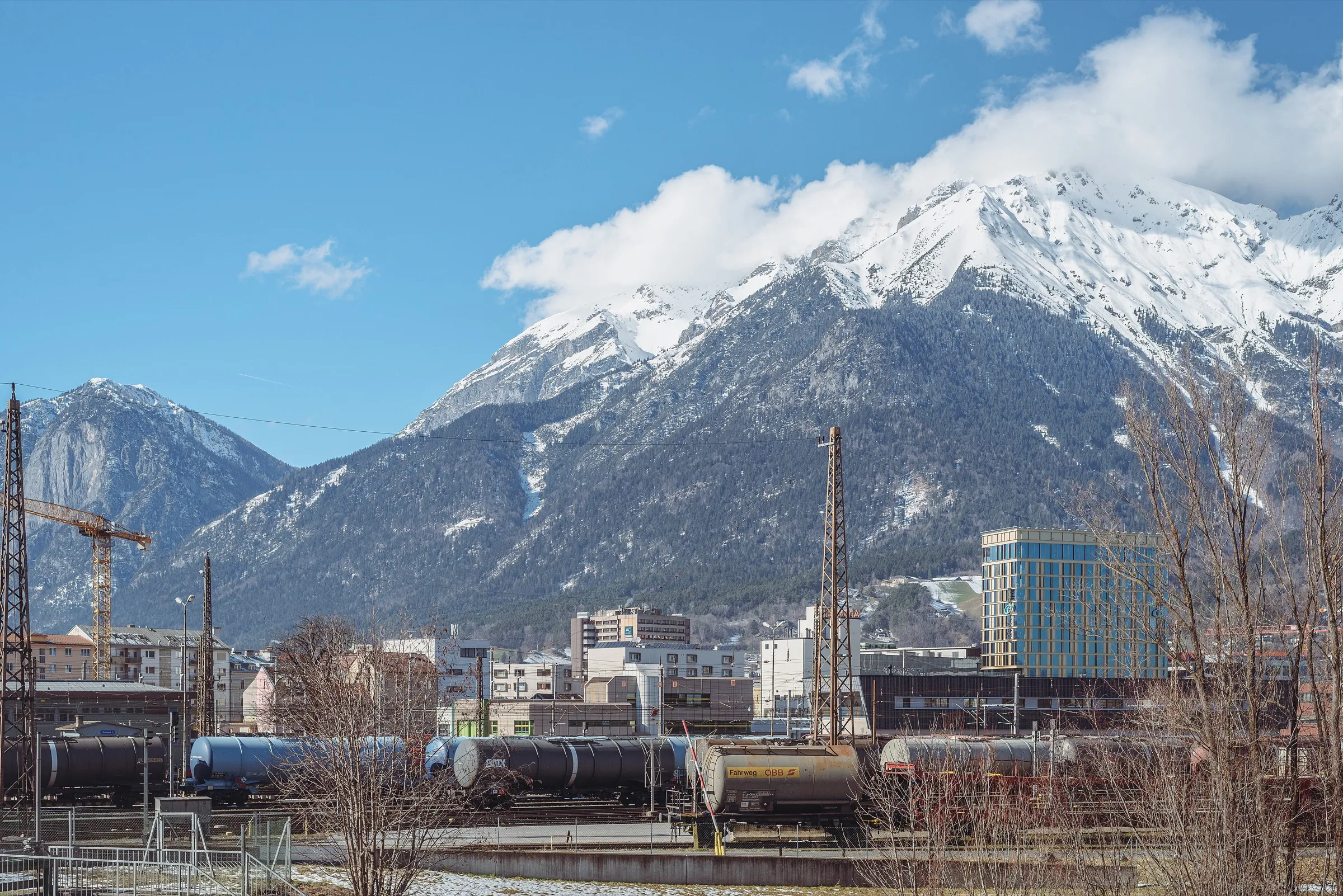
Innsbruck needs its own warning, because it is the Tyrolean name most people recognise and it is not a ski resort. It is a city with an excellent railway station, from which the Nordkette is a cable car ride and everywhere else in Tyrol is a further train. Read a list that puts Innsbruck between St. Anton and Kitzbühel as though the three were equivalent and you will book a city hotel for a ski week.
The catch in the rest of Tyrol is the valleys. The Paznaun and the Ötztal are long dead-end roads, and no train has ever gone up either. A railway that stops at the mouth of a valley is not a failure of the railway, it is what happens when a long valley ends in a glacier and has one road in.
Slovenia
| Station | The train reaches | The last mile | Headline service |
|---|---|---|---|
| Jesenice | Kranjska Gora | Bus, taxi or the valley cycle path, 20 km | Mainline from Ljubljana, Karawanks line from Villach |
| Lesce-Bled | Bled | Bus from opposite the station, taxi, or a paved path, about 4 km | Ljubljana to Villach mainline |
Read these two rows as a warning rather than a verdict: both stations are real, both are easy to reach from Austria, and neither one is near the skiing. Slovenia is missing from every competing list of rail-reachable ski areas, which is convenient for the lists and unhelpful for anyone who was going to try it.
What time does the last bus leave?
Nobody publishes it.
That is the single most useful finding in this whole exercise, and it is the one nobody writes down. Across all fourteen gateways, checked against the operator’s or resort office’s own timetable page, the number of published last winter departures is zero. Not “hard to find”. Not “varies by date”. Absent.
Exactly one operator publishes a winter frequency: Zell am See-Kaprun gives line 660 as every 15 minutes from 19 December 2026 to 4 April 2027, dropping to every half hour over the middle of the day. It is also the only page in the set that is specific about what the ride costs: included in the Ski ALPIN CARD during lift operating hours, and free to everyone only within Kaprun itself. A ski bus described elsewhere as simply free is neither of those things outside those two conditions.
Davos is the honest exception, and it is honest by refusing to give a time at all. Since June 2025 the evening service there is an on-demand minibus, booked in an app, running daily from 8 p.m. There is no last departure because there is no fixed route.
Figures that circulate widely do give a clock time for the last bus out of St. Anton am Arlberg. That time comes from a journey-planning app rather than the operator’s own timetable. It may well be right, and it is not sourced well enough to print, which is the same standard applied to every other row on this page. Do not plan a late arrival around it.
So the practical rule is blunt. Check the operator’s own timetable for the specific dates you are travelling, and do it before you book the flight rather than after, because the flight is the leg you cannot move.
Two questions settle almost every case. Does a bus still run when your train is scheduled to arrive, and does another one run an hour later if the train is late? A last mile with an hourly service and a published final departure is a last mile you can plan around. A last mile with neither is a taxi you have not booked yet.
Does the train really go all the way to Zermatt?
Yes, right into the middle of it, and never in one train.
Zermatt has always been car-free, so the railway is not a convenience there, it is the road. The line is narrow gauge, which is why every journey from an airport or a mainline changes at Visp or Brig onto the Matterhorn Gotthard Bahn. There is no direct service from Geneva or Zurich airport, and the change is the normal way in rather than a problem. From Täsch, where drivers leave their cars, shuttle trains run every 20 minutes and take 12 minutes, and the final stop is the centre of the village.
That is the best last mile in the Alps, and it is a train.
Can you reach Sölden, Ischgl, Tignes or Val d’Isère by train?
No. Not one of them.
All four are among the most searched ski destinations in Europe and none of them has ever had a station. Sölden is about 55 minutes up the valley from Ötztal Bahnhof on Postbus 320, and Obergurgl about 80. Ischgl is a Postbus ride up the Paznaun from Landeck-Zams, on a service whose winter frequency is not published anywhere we could read it. Tignes and Val d’Isère are about 45 minutes by bus from Bourg-Saint-Maurice.
Kranjska Gora belongs in the same paragraph and usually is not. It appears on published lists of resorts you can reach by train, and its own tourist office says the last passenger train left in 1966. The rail approach today is Jesenice, about 20 km away, finished by bus, taxi or the cycle path that follows the old track bed.
What these four have in common is not a gap in the network but a shape of ground. Each sits at the top of a single valley road, above the last village a railway could economically reach, and each was built as a ski development rather than as a town that later took up skiing. Sölden and Ischgl are exactly where a private transfer earns its place, and the two live routes for them are linked beside this page rather than dropped into this paragraph.
Is there a direct ski train from London or Paris?
From Paris, yes. From London, one change at Lille.
The Eurostar Snow Train runs from London to the Tarentaise on winter Saturdays, calling at Chambéry, Albertville, Moûtiers, Aime-La-Plagne, Landry and Bourg-Saint-Maurice. Eurostar’s own page describes it as a connection at Lille Europe, where London passengers join the through train from Amsterdam and Brussels; most guides still call it direct. For 2026/27 the outbound season runs 19 December 2026 to 20 February 2027, and the return runs 27 December 2026 to 28 February 2027 on Sunday mornings and selected Saturday afternoons. Most guides quote the season as 19 December to 28 February, which quietly merges the two windows; the last outbound Saturday is 20 February 2027.
Book the last week of February southbound and there is no train to be on.
From Paris, the Travelski Night Express is a Friday-night sleeper down the same corridor, with a first outbound on 18 December 2026 and a last on 26 March 2027, and from this winter it also works from Amsterdam and Brussels. Amsterdam additionally has Nightjet NJ421 to Innsbruck, nightly and year-round, which is the only through train from the Low Countries to Austria worth planning around.
On the Tarentaise corridor the train is simply the better trip, and there is no point pretending otherwise. Two adults with a ski bag each, boarding at St Pancras and stepping off at Bourg-Saint-Maurice with one same-platform-hall change, no airport, no hold-luggage desk and a funicular waiting by the platform, have the best-designed ski journey in Europe. No transfer beats it, and nothing on this page is written to imply otherwise.
The bound on that is the calendar. It is one corridor, one day a week, and about nine weeks long.
Everything else from London needs a change at Paris or Brussels, and a longer one. No operator publishes a single through time from London to a Swiss or Austrian gateway on a winter Saturday, which is why you will not find one here: the honest version is two legs, each with its own timetable, and the change is where the day is won or lost.
Will the trains take your ski bags?
They will, and on the routes that matter they are free.
Eurostar allocates extra space on the snow trains to Bourg-Saint-Maurice, so one pair of skis or one snowboard travels in addition to the standard adult luggage allowance, provided it is in a protective case covering the whole item with straps attached. On every other Eurostar route the same kit counts as one of your two pieces, which is the trap for anyone routing via Paris rather than taking the direct train.
SNCF allows one pair of skis per passenger in a labelled bag as hand luggage, with a snowboard case capped at 90 x 130 x 50 cm, and requires that you can carry everything you brought in one go. SBB carries skis, boots, poles and snowboards free in the ordinary racks. The new-generation Nightjet stock has a multifunction car with a dedicated area for skis and snowboards at no extra charge, which is a better arrangement than a rack in a corridor at two in the morning.
The practical consequence is about handling rather than allowance. Every one of these rules assumes you can lift your own kit onto a rack, keep it out of a corridor and take it off again at a station that may give you four minutes and a set of stairs. That is easy with one bag each and two people, and it is the whole argument on the other side with four of each.
The trains are not the problem. The bus is.
What changes on 13 December 2026?
Every timetable in Europe, on the same night.
The annual change lands on the second Saturday of December, and in 2026 that is 13 December. Seasonal ski trains are defined inside the new timetable rather than carried over from the old one, so a season date, a stop or a clock time published before that night is a forecast. That includes the two clock windows on this page, the KitzSki free-train hours and the line 660 frequency, both read on 17 September 2026.
Three things are worth re-checking yourself after that night, whatever any page tells you: the exact Saturdays the seasonal trains run, whether your connection still exists at the same minute, and whether the local bus you were relying on kept its winter frequency. The first two move most years. The third moves quietly and nobody announces it.
This site re-reads them after the change and re-dates the pages. If you are reading a rival page that quotes a 2026/27 departure time and carries no retrieval date, assume it was copied from last season.
Which gateways are worth knowing beyond these fourteen?
Several, and two of them beat most of the table.
The launch fourteen were chosen on measured search demand and on where a verdict was genuinely in doubt, not on how good the railway is. These are the ones that came closest and will be built next:
- Klosters Platz, Switzerland. The Gotschna cable car base is next to the platform, which makes it the shortest last mile on the Rhaetian Railway network, Davos included.
- Mayrhofen, Austria. The terminus of the narrow-gauge Zillertalbahn, with an hourly line 4104 bus to the Hintertux glacier taking about 40 minutes.
- Engelberg, Switzerland. A direct express from Lucerne, about 43 minutes, six a day, and the Titlis base is a walk from the station.
- Wörgl, Austria. A free ski bus of about 15 minutes into the SkiWelt at Söll and Ellmau, from a station on the main Vienna to Innsbruck line.
- Oberstdorf, Germany. A free shuttle to the Fellhornbahn, at the end of a branch line with direct trains from Munich.
- Bad Gastein, Austria. Unusual in having only long-distance trains and no local service, which is excellent for arriving and awkward for moving about afterwards.
None of these has a page yet. The pattern across all of them is the one the table already showed: the railway is rarely the weak leg.
What is missing from the wider corpus is more interesting than what is in it. Across seventy-nine Alpine gateway stations reviewed for this site, the destinations that most people search for by name are consistently the ones with no station and no published bus, while the stations with a lift at the end of the platform sit in valleys nobody types into a search box. The rail network and the marketing budget were built by different people for different reasons, and they do not line up.
When does a transfer beat the train?
Four cases, and only four.
Three or more people with full ski equipment. Most operators cap sports kit at one set per passenger, which is fine until the set has to cross a platform with everything else you brought. SNCF states the test plainly: you have to be able to carry all of your own baggage at once. Three people who each pass that test individually do not automatically pass it as a group with a tight connection and a footbridge.
A late arrival, after the last onward bus. This is the case the whole middle of this page is about. You cannot look up when that bus was at any of the fourteen gateways here, so a late landing at Landeck-Zams or Ötztal Bahnhof is a decision you are making without the information.
Saturday. The Alps change over on the same day, so the valley roads and the ski buses are structurally overloaded regardless of how good the printed frequency looks, and the Tarentaise is the worst of it because three valleys of resorts funnel through one town.
A last mile that is taxi only. Rare on this list, common one valley over, and the one case where the comparison is not train against transfer but transfer against a taxi you are hoping is there.
Nothing on this page argues for a transfer at Zermatt, Chamonix, St. Anton am Arlberg, Kitzbühel or Davos. The train wins there outright and it is not close.
Outside those four cases, take the train.
When the last mile is the problem
Three or more of you with ski bags, a late arrival, or a Saturday changeover: the onward bus is where the train journey stops being easy.
Private transfer
One fixed price for the whole car, from the airport to the door.
TransferBnB and this site are both run by Green Wire Media. This link is ours, not a paid placement.
Frequently Asked Questions
Which Alpine ski resorts have a railway station in the village itself?
Among the fourteen gateways covered here: Zermatt, Chamonix, St. Anton am Arlberg, Kitzbühel and Davos. In all five the train stops inside the place you are skiing, and nothing else is needed to reach the village.
Do you have to change trains to reach Zermatt?
Yes. Zermatt is car-free and sits at the end of a narrow-gauge line, so every journey changes at Visp or Brig onto the Matterhorn Gotthard Bahn. From Täsch, shuttle trains run every 20 minutes and take 12 minutes to the centre of the village.
Can you get to Sölden, Ischgl, Tignes or Val d'Isère by train?
No. None of the four has a station. Sölden is about 55 minutes by Postbus 320 from Ötztal Bahnhof, Ischgl is a Postbus ride up the Paznaun from Landeck-Zams, and Tignes and Val d'Isère are about 45 minutes by bus from Bourg-Saint-Maurice.
Is there a direct train from London to the French Alps this winter?
Nearly. The Eurostar Snow Train runs on Saturdays with one change at Lille Europe, where you join the through train from the Benelux. It runs outbound from 19 December 2026 to 20 February 2027 and returns from 27 December 2026 to 28 February 2027, calling at Chambéry, Albertville, Moûtiers, Aime-La-Plagne, Landry and Bourg-Saint-Maurice.
What time does the last ski bus leave from an Alpine station in winter?
Almost no operator publishes it. Of the fourteen gateways here, not one prints a last winter departure on its own timetable page, so the honest answer for any given date is to check the operator's timetable before you book a late arrival.
Do European trains take ski bags, and do they cost extra?
They take them and, on the routes that matter, they are free. Eurostar carries one pair of skis or one snowboard in addition to the standard adult allowance on the snow trains to Bourg-Saint-Maurice, in a case that covers the whole item. SBB carries winter sports equipment free in the ordinary racks.
Can you reach Kranjska Gora by train?
No. The last passenger train ran in 1966. The rail approach is Jesenice, about 20 km away, finished by bus, taxi or the valley cycle path.
Stations in this piece
- Bourg-Saint-Maurice: The train ends at Bourg-Saint-Maurice; Les Arcs is a funicular ride, Tignes and Val d'Isere need a bus or a transfer.
- Chamonix-Mont-Blanc: The train reaches Chamonix itself; the town centre and Aiguille du Midi cable car are a short walk from the platform.
- Davos Platz: The train ends at Davos Platz, a five-minute walk from town; Parsenn is reached by cable car.
- Innsbruck Hauptbahnhof: Innsbruck Hauptbahnhof is a city interchange, not a resort gateway: Nordkette is reached by cable car, Igls by bus.
- Interlaken Ost: The train ends at Interlaken Ost; Grindelwald, Lauterbrunnen and Wengen are all a further rail change.
- Jesenice: The train stops at Jesenice; Kranjska Gora has no station of its own and is a bus ride further on.
- Kitzbühel Hauptbahnhof: The train stops in town; the Hahnenkammbahn base is a short walk, Kirchberg in Tirol a bus ride.
- Landeck-Zams: The train stops at Landeck-Zams; Ischgl and Serfaus-Fiss-Ladis are reached onward by bus.
- Lesce-Bled: The train stops at Lesce-Bled; the lake and town are a bus ride, taxi, or a walk from the station.
- Moutiers - Salins - Brides-les-Bains: The train stops at Moutiers; Courchevel and Meribel are a bus away, Val Thorens and Les Menuires further still.
- Zermatt: The train takes you to the door in Zermatt.
- Oetztal Bahnhof: The train stops at the valley mouth; Soelden and Obergurgl are a bus ride further up.
- Zell am See: The train stops in town; Kaprun and the Kitzsteinhorn are a ski bus away, included with the lift pass, and Schmittenhohe is a cable car ride.
- St. Anton am Arlberg: The train stops in the village; the Galzigbahn base is a short walk and a free ski bus covers the rest.
Sources
- Eurostar, Snow Train
- Eurostar, sports and camping equipment
- Les Arcs, arriving by train
- Zermatt, arrival
- Davos, getting there
- St. Anton am Arlberg, travel
- KitzSki, bus and train
- Zell am See-Kaprun, ski bus
- Kranjska Gora, take a train ride
- Bled, by train
- Travelski Night Express
- Nightjet, Innsbruck
- SNCF Connect, travelling with luggage
- SBB, luggage
- Rhaetian Railway, Klosters Platz
- Hintertux glacier, ski bus
- seat61, booking horizons